

Umbilical Hernias
Umbilical hernias are the second most common type of hernia after inguinal hernias. An umbilical hernia forms at the belly button, or the umbilicus. Just like other hernias, a hole forms in the muscles under the umbilicus and fat or intestines push through the hole.

The basics of an umbilical hernia:
The umbilicus is prone to muscle weakness since it's where the greatest stress is placed on the muscles when we do anything physical. In children these hernia often go away on their own, but in adults these hernias never get better and usually get bigger over time.
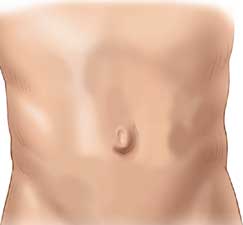
Umbilical hernias can be directly under the belly button, or sometimes slightly above or below it. They can look like a small marble under the skin, or as they get larger they can look like a golf ball and sometimes a tennis ball (if left untreated).
Symptoms of an Umbilical Hernia:
Like most other hernias, pain at the belly button or navel is one of the most common symptoms. Also, due to the fat and intestines pushing through the hernia, a bulge can often form under the skin. This bulge can get bigger and smaller depending on what is in the hernia.
Over time, if the hernia gets large enough, the intestine can get permanently trapped, which can lead to damage to the intestine, as well as other symptoms like nausea, vomiting, and constipation.
Read more about symptoms HERE.
How are umbilical hernias repaired?
Since no hernia can heal on its own, surgical repair is required. The option for most umbilical hernias is open surgery since the hole is usually very small. Laparoscopic surgery can be used for umbilical hernias but is usually reserved for recurrent hernias and very large hernias.
We perform a tension free mesh repair technique utilizing the latest mesh available. Mesh helps prevent recurrences after the hernia repair by strengthening the muscle around the hernia defect. Learn more HERE.
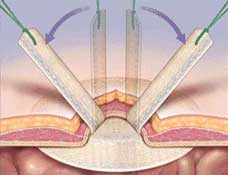
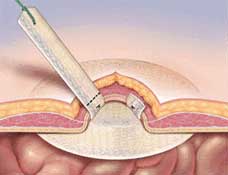
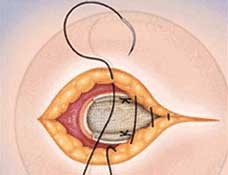
During open surgery, a small incision is made in the crease under the belly button. The belly button is lifted off of the underlying muscle and fat. The hole in the muscle is exposed and a mesh is placed through the hole.
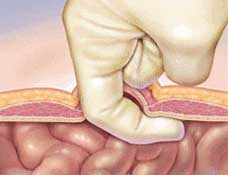
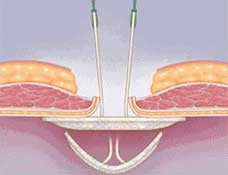
The mesh is then sutures (sewn) to the surrounding healthy muscle in several locations. Once the mesh is securely fastened to the muscle, the belly button is replaced down to the muscle or fat and the skin is sewn closed.
About Umbilical Hernias Video:
Dr. Todd S. Harris explains what an umbilical hernia is and a little about how they are treated.
Open Umbilical Hernia Repair Video
In the video below, Dr. Harris narrates an open umbilical hernia repair done at California Hernia Specialists' hernia center.
Recurrent Umbilical Hernias
Although umbilical hernias can often be repaired once and never recur, if they are repaired poorly, there is an increased risk of recurrence. These cases can quickly become challenging as the hole in the muscle gets larger and larger, making the surgeries more and more difficult.
This patient had been operated on two previous times by an outside surgeon. The first surgery was done without mesh. After it recurred almost immediately, the same surgeon used a 'large piece of mesh' as was described by the patient and the operative report. Unfortunately shortly after this surgery, the bulge returned and the patient developed increasing pain.
The patient presented to California Hernia Specialists for a second opinion before returning for a third surgery. The patient underwent a physical exam and a CT scan to evaluate the size of the hernia. A number of options were presented to the patient and ultimately it was decided to treat him with an open recurrent umbilical hernia repair.
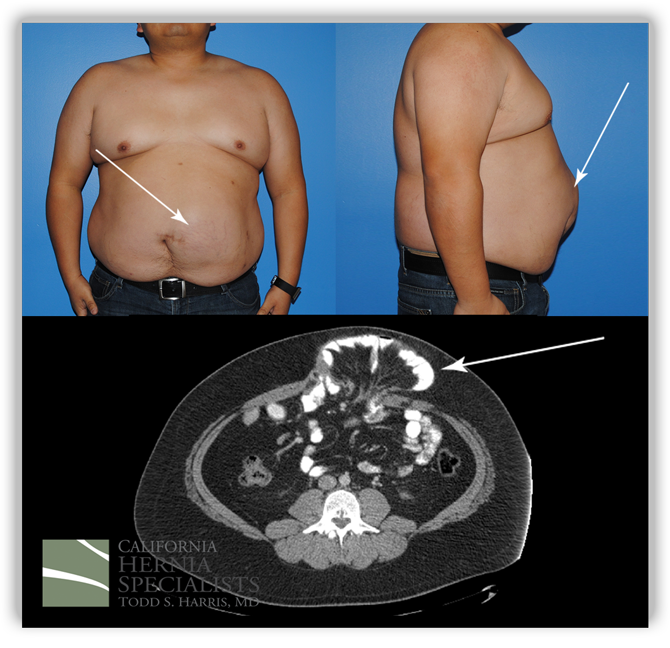
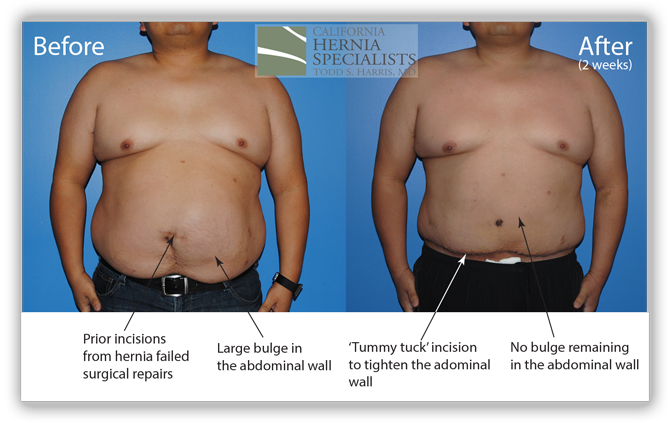
A 'tummy tuck' incision was used to help tighten and remove excess skin and the old scar. The old mesh had completely separated from the muscle and was stuck to the small intestines internally. Careful removal of the mesh was required to free the intestine from the hernia. The muscle was closed and a new piece of advanced mesh was placed under the muscle to reinforce the repair. The images below are from before and after his hernia surgery.
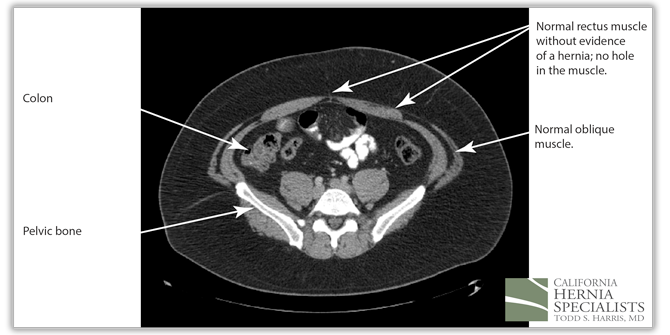
This image shows photos before his surgery along with the CT image corresponding to his hernia. The arrows point out the obvious hernia.
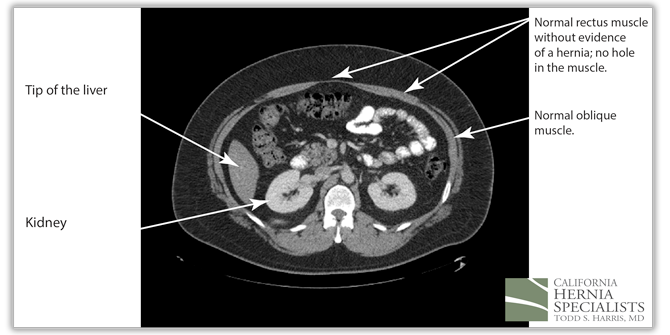
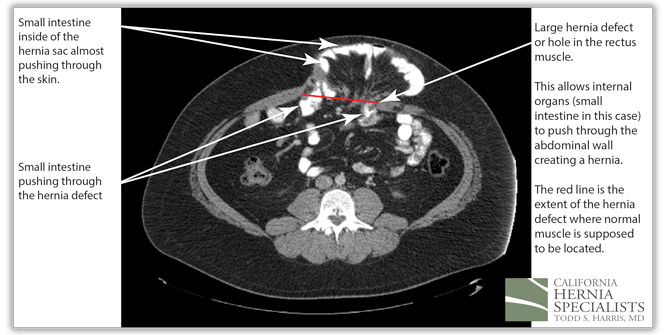
These 3 CT scan images show the patients muscle above the hernia where the muscle is normal, at the level of the hernia, and then below the hernia again where the muscle is normal.
In the images below we compare the pre-operative photos to the post-operative photos taken just 2 weeks after his surgery.
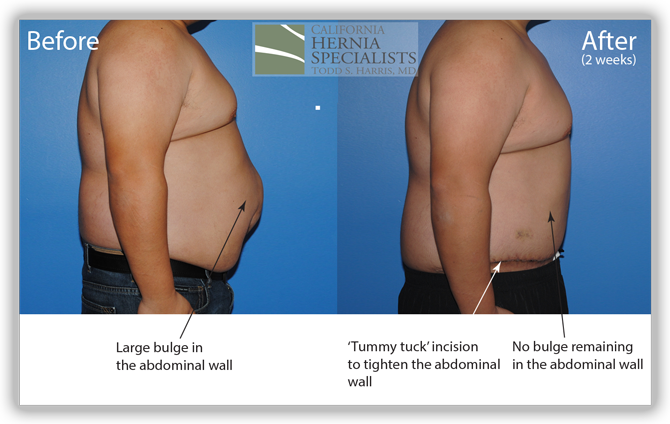
The patient continued to lose weight after his surgery. He was followed for 6 months and did very well throughout this time returning to normal activities after about 4-6 weeks.
Important points to consider when choosing a hernia surgeon:
- The newest, advanced lightweight mesh can reduce not only recurrence rates for hernias, but also reduces the chance of postoperative mesh pain to almost zero.
- Being treated at a specialized hernia center with an in-house accredited ASC provides the highest quality care before, during, and after your hernia surgery.
- Patients should be seen by a surgeon who can offer all forms of hernia surgery, including open lightweight mesh techniques, as well as advanced laparoscopic techniques. This ensures the surgeon can offer the best technique tailored for each patient.
- Costs for uninsured patients are approximately $1500 for the surgeon fees, and $2000 for the surgery center fees (including OR time, materials, and recovery) for a total of approximately $3500.
- Some laparoscopic patients experience less pain post-operatively and may be able to return to normal activities sooner (when compared to traditional hernia repair). Laparoscopic hernia surgery can result in better patient experiences for some patients.
- Nuestra oficina habla español. Haga clic aquí para español.

Dr. Harris sees patients from all over Southern California, the greater US, and Canada. Our Newport Beach office is conveniently located in Central Orange county adjacent to John Wayne Airport between the 405, 73, and 55 highways.
Our office staff are experienced in verifying insurance coverage for each patient, as well as offering excellent pricing for patients without insurance (see costs above). We are happy to discuss all forms of payments with patients as needed.