

About Hernia Surgery
Hernia surgery today is much more advanced than even five years ago. The use of laparoscopic surgery techniques and the newest, lightweight meshes (if needed), often allow patients to heal faster, in less pain, and have a more cosmetic outcome. Patients who are deciding on where to have hernia surgery should make sure that their surgeon has all the tools available to offer the most state-of-the-art techniques and mesh to their patients.

Hernia surgery can be described based on three specific categories:
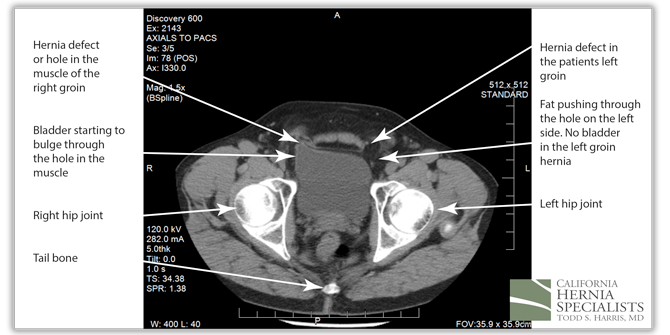
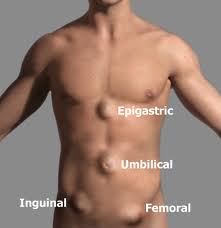
- Where the hernia is located: inguinal hernias (groin hernia), umbilical hernias (belly button hernia), as well as less common incisional, femoral and ventral hernias
- How the hernia is repaired: traditional open repair or laparoscopic
- They can be further classified as: unilateral (one side of the body), bilateral (both sides of the body), or recurrent (after a prior surgical repair)
i.e. Laparoscopic, bilateral, inguinal hernia repair
Open versus Laparoscopic Hernia Surgery
The two major types of hernia surgery are traditional open surgery, and laparoscopic surgery. No one approach is suitable for every patient. Patients with certain types of hernias may benefit from open hernia surgery while another similar patient may need laparoscopic hernia repair. The size of the hernia, the location, and whether it is unilateral or bilateral influences the best approach. Patients should read our "Comparison of Open & Laparoscopic Hernia Surgery" page to read the pro's and con's of each type of surgery.
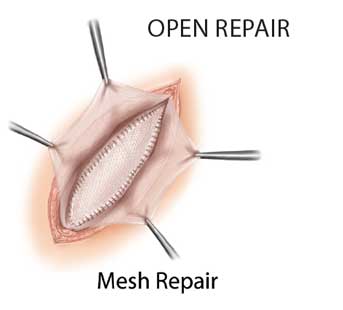
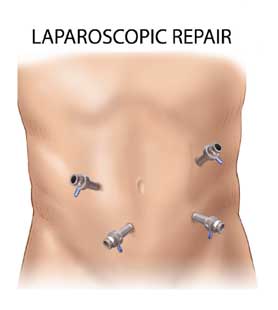
Tension Free Hernia Surgery
The term 'tension free' hernia surgery is commonly used to describe hernia surgery. Hernias are caused by a weakening of the abdominal muscles. Some surgeons choose to sew the muscles back together, thus causing 'tension' on the muscles around the hernia. However, the muscles around a hernia are already weak, and over time those muscles tend to pull apart and the hernia can recur, or come back. Therefore, most hernia specialists today utilize a mesh to help strengthen the muscles after hernia repair. When using a mesh, the muscles themselves are not sewn together (see below). Instead, a mesh is placed over or under the hole in the muscle to prevent anything from pushing through the abdominal wall.
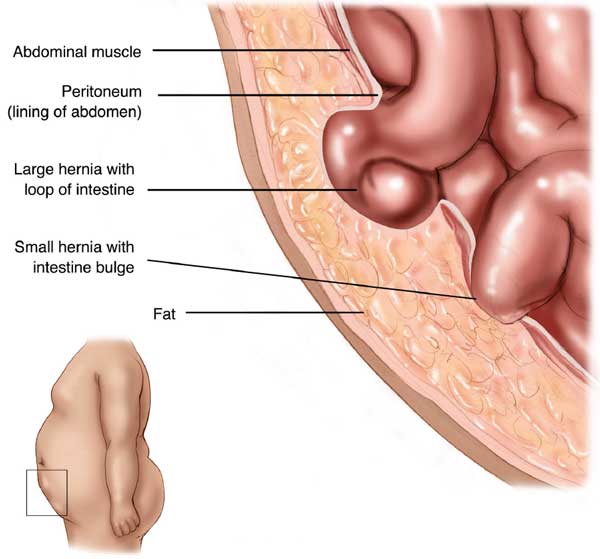
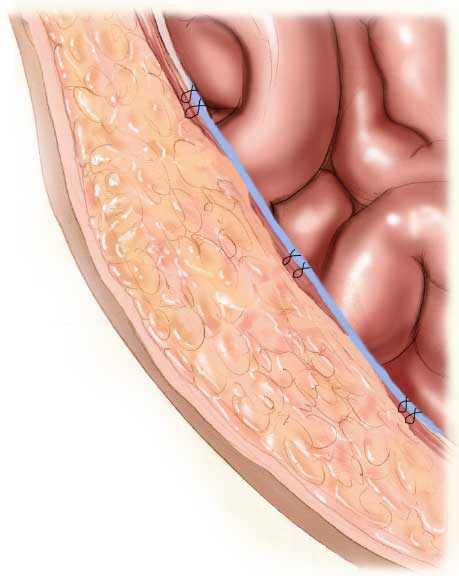
Some patients have heard or read negative information about mesh surgery. However, the unbiased government agency The National Institutes of Health performed a study of whether mesh should or should not be used for hernia surgery. Read the article by clicking on the logo to the right. While there are some risks with mesh, by utilizing the newest mesh available, these risks are minimized.

Patients can read more on our "Truths About Hernia Mesh" page.
Our Approach
Dr. Harris specializes in surgical repair for all hernia types. For patients who require a laparoscopic surgery, Dr. Harris commonly performs these procedures. When performing a tension free mesh hernia repair, Dr. Harris uses the latest and most advanced lightweight mesh available which significantly reduces pain and discomfort after the surgery. Many surgeons still use mesh which was invented 10 years ago which can increase the chances of post operative mesh pain. Today's advanced mesh reduces those risks to almost zero.
Although basic open surgical hernia repair is still an important option for some patients, every patient should consider being seen by a surgeon who can perform advanced laparoscopic hernia surgery and who uses the newest lightweight mesh. Only a small handful of the hundreds of general surgeons in Orange County, Los Angeles, Riverside and San Diego have the experience to perform hernia surgeries using laparoscopic techniques and use cutting edge lightweight mesh.
What to expect on your day of surgery
In the video below, Dr. Todd S. Harris describes what to expect on your day of surgery. Patients are asked to stop any blood thinners that they are taking at least 5 days prior to surgery. We require someone to be with patients at the time of their discharge after surgery and encourage them to have someone with them for the first 24 hours post-operatively if possible.
Listen to our past patients discuss their experiences with this topic:
Important points to consider when choosing a hernia surgeon:
- The newest, advanced lightweight mesh can reduce not only recurrence rates for hernias, but also reduces the chance of postoperative mesh pain to almost zero.
- Being treated at a specialized hernia center with an in-house accredited ASC provides the highest quality care before, during, and after your hernia surgery.
- Patients should be seen by a surgeon who can offer all forms of hernia surgery, including open lightweight mesh techniques, as well as advanced laparoscopic techniques. This ensures the surgeon can offer the best technique tailored for each patient.
- Costs for uninsured patients are approximately $1500 for the surgeon fees, and $2000 for the surgery center fees (including OR time, materials, and recovery) for a total of approximately $3500.
- Some laparoscopic patients experience less pain post-operatively and may be able to return to normal activities sooner (when compared to traditional hernia repair). Laparoscopic hernia surgery can result in better patient experiences for some patients.
- Nuestra oficina habla español. Haga clic aquí para español.

Dr. Harris sees patients from all over Southern California, the greater US, and Canada. Our Newport Beach office is conveniently located in Central Orange county adjacent to John Wayne Airport between the 405, 73, and 55 highways.
Our office staff are experienced in verifying insurance coverage for each patient, as well as offering excellent pricing for patients without insurance (see costs above). We are happy to discuss all forms of payments with patients as needed.