

Inguinal Hernias
Inguinal hernias are the most common type of abdominal hernia seen by hernia surgeons.
They are located in the groin area and are more common in men. As with all hernias, surgical repair or hernia
surgery is required to fix them since they don't go away on their own.
Many patients ask "what is an inguinal hernia?" or "how does an inguinal hernia form?". We hope that by
reading the information below, that patients can understand more about inguinal hernias.

The basics of an inguinal hernia:
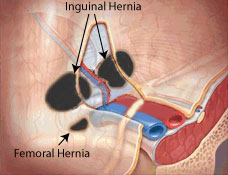
Inguinal hernias, also known as groin hernias, are when the intestines or fat push through the muscles into the inguinal canal. This is the layer of muscles in the groin which houses the spermatic cord in men, or the round ligament in women. The hernia can be directly through the muscle (direct inguinal hernia) or the hernia can follow the round ligament or spermatic cord through it's indirect path as they exit the abdomen (indirect inguinal hernia).
Up to 75% of abdominal hernias are inguinal hernias. They can be found in men and women, but more commonly in men due to the fact that men have a larger opening in the abdominal wall because of the spermatic cord. Inguinal hernias often develop as small bulge that enlarges over time. The bulge may disappear while lying down and return with activity.

Symptoms of an Inguinal Hernia:
Like most other hernias, pain in the groin is one of the most common symptoms. Also, due to the fat and intestines pushing through the hernia, a bulge can often form under the skin. This bulge can get bigger and smaller depending on what is in the hernia.
Over time, if the hernia gets large enough, the intestine can get permanently trapped, which can lead to damage to the intestine, as well as other symptoms like nausea, vomiting, and constipation.
Read more about symptoms HERE.
How are inguinal hernias repaired?
Since no hernia can heal on its own, surgical repair is required. Options for hernia repair include open surgery, and laparoscopic surgery. Both options are well studied and have excellent outcomes. No one option is right for all patients which is why we feel it is important to offer BOTH to patients. Learn more HERE.
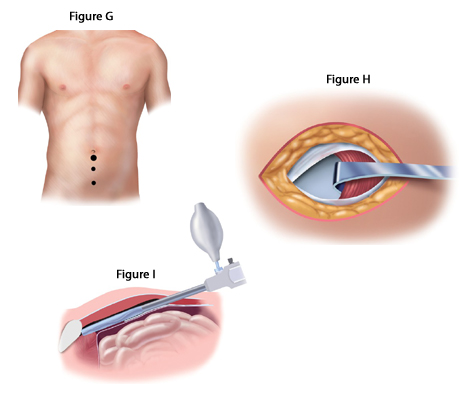
A laparoscopic inguinal hernia requires a 1-2cm incision at the belly button, and two smaller punctures below the umbilicus. The belly button incision allows the camera to view the inside of the abdomen and the two smaller punctures are for the operating instruments.
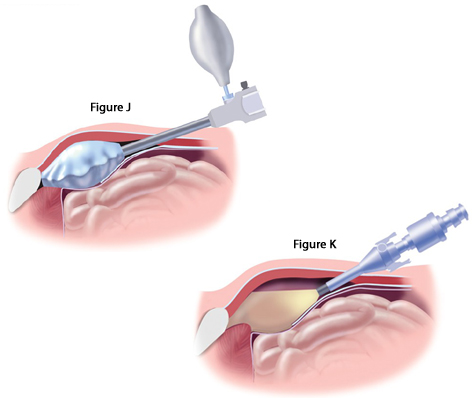
We perform a tension free mesh repair technique utilizing the latest mesh available. Mesh helps prevent recurrences after the hernia repair by strengthening the muscle around the hernia defect. Learn more HERE.
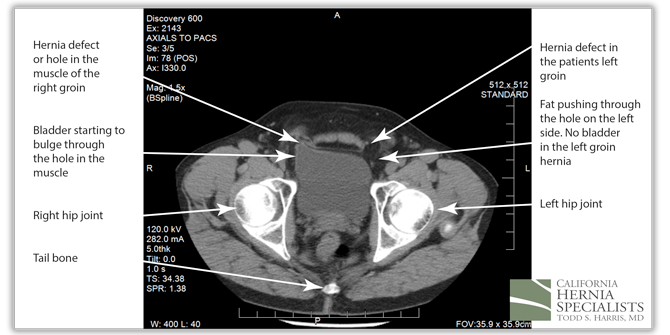
Inguinal hernias are caused by a hole in the muscle of the groin. This hole can either be lateral to the blood vessels (indirect inguinal hernia), or towards the middle from the blood vessels (direct inguinal hernia). Regardless, in open surgery, the muscle layers over the weakened muscle are opened. The hole (or holes) in the muscle are found. A dual sided mesh is used to reinforce the hernia defect and the muscle around the hole.
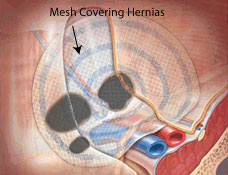
The dual mesh allows one layer (with the blue circles) to be placed under the muscle, while the other top layer is placed over the damaged muscle. With this type of repair, the weakened muscles are treated from both the inside AND the outside of the hole. This cannot be done in laparoscopic surgery since only an inner layer mesh can be used.
Laparoscopic Inguinal Hernia Repair
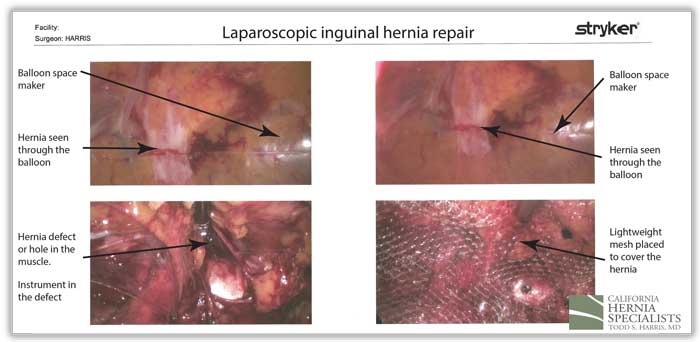
This patient had a noticeable bulge in the left groin. He opted for laparoscopic surgery for treatment. The balloon spacemaker (see above) is placed under the muscle but over the intestines. When the balloon is removed, the hole in the muscle is found. A lightweight mesh is placed over the defect to repair the hernia.
About Inguinal Hernias Video
Dr. Todd S. Harris discusses the most common type of hernia: the inguinal hernia.
Narrated Inguinal Hernia Repair Video
Dr. Todd S. Harris narrates a video of an open inguinal hernia repair.
Important points to consider when choosing a hernia surgeon:
- The newest, advanced lightweight mesh can reduce not only recurrence rates for hernias, but also reduces the chance of postoperative mesh pain to almost zero.
- Being treated at a specialized hernia center with an in-house accredited ASC provides the highest quality care before, during, and after your hernia surgery.
- Patients should be seen by a surgeon who can offer all forms of hernia surgery, including open lightweight mesh techniques, as well as advanced laparoscopic techniques. This ensures the surgeon can offer the best technique tailored for each patient.
- Costs for uninsured patients are approximately $1500 for the surgeon fees, and $2000 for the surgery center fees (including OR time, materials, and recovery) for a total of approximately $3500.
- Some laparoscopic patients experience less pain post-operatively and may be able to return to normal activities sooner (when compared to traditional hernia repair). Laparoscopic hernia surgery can result in better patient experiences for some patients.
- Nuestra oficina habla español. Haga clic aquí para español.

Dr. Harris sees patients from all over Southern California, the greater US, and Canada. Our Newport Beach office is conveniently located in Central Orange county adjacent to John Wayne Airport between the 405, 73, and 55 highways.
Our office staff are experienced in verifying insurance coverage for each patient, as well as offering excellent pricing for patients without insurance (see costs above). We are happy to discuss all forms of payments with patients as needed.